A new privacy warning aimed at LG television owners argues that the safest response to the company’s smart-TV data practices may be to take the set offline entirely. On the event date, September 8, 2026, AppleInsider summarized a September investigation by Gamers Nexus and said that disconnecting Ethernet and clearing Wi-Fi credentials is the only reliable way to stop the television element from collecting and sending data.
The article’s central point is simple: using an external box such as Apple TV does not, by itself, prevent the television from gathering information. AppleInsider says the LG panel itself can still act as a privacy risk because the smart-TV layer remains active even when most viewing happens through another device. That distinction matters for people who assume the set is inert once it is no longer their primary app launcher.
AppleInsider describes the findings as extending beyond basic usage analytics. According to the piece, the investigation found behavior associated with advertising personalization, automatic content recognition, microphone use and local-network scanning. In the report’s framing, the concern is not only that the television knows what is being watched, but that it may also be collecting data from the room and from nearby devices.
The article says some LG televisions were observed capturing audio from microphones, including when the set appeared to be in standby mode, and that the material could later be uploaded once the device reconnected to the internet. It also says researchers found evidence that audio snippets were stored locally when the set was disconnected. The implication is that network isolation can reduce exposure, but does not guarantee the television stops recording data altogether.
AppleInsider also reports that the security research showed the televisions scanning the local network for other hardware, including phones, smartwatches and other connected devices. That behavior may be less surprising on a smart appliance than on a dumb display, but the article presents it as part of a broader pattern of overreach. The problem, as framed in the story, is not just that the television can discover devices. It is that the collection is extensive enough to create a profile of the household and its environment.
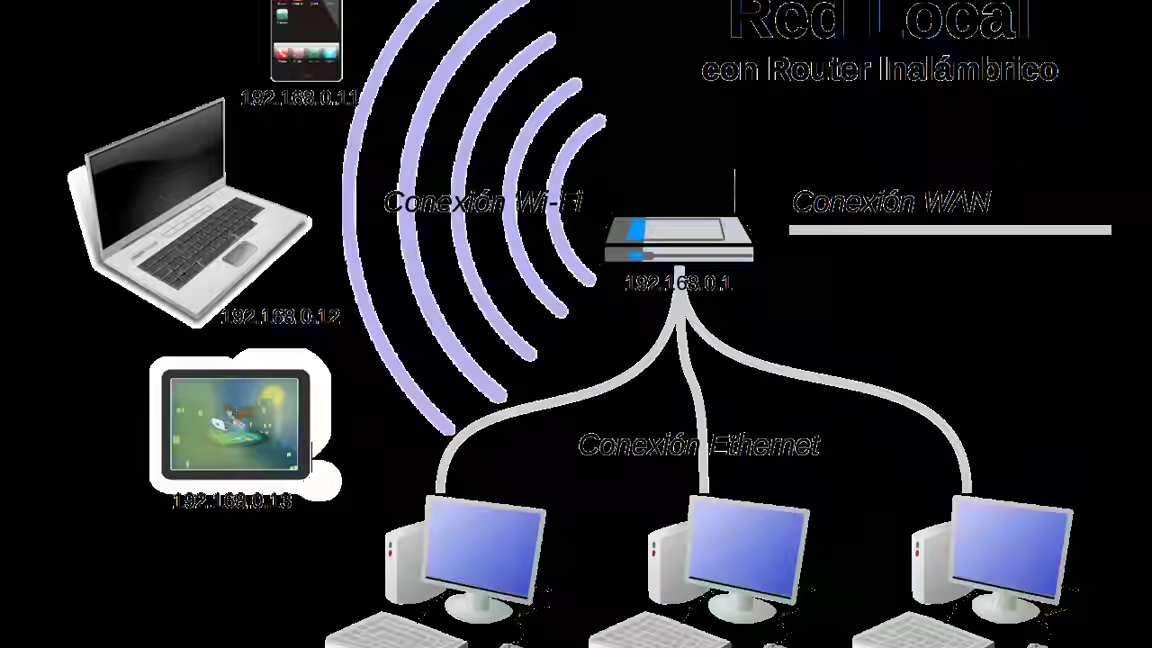
The write-up emphasizes that the ad-tech and telemetry systems are difficult to avoid through software settings alone. It says that even if owners turn off the connected features they use least, the underlying smart-TV platform can still be active in the background. The article’s advice is therefore hardware-oriented: unplug Ethernet, forget Wi-Fi credentials, or block the set at the router if direct access is not practical.
That advice is uncomfortable because it treats a high-end television like an appliance that needs to be functionally downgraded before it becomes safe. AppleInsider’s summary suggests the issue has persisted for years and that the latest research only adds more detail to an old complaint about smart TVs. The question is not whether the set can access the internet. It is whether the user wants the television to remain part of the home’s data surface at all.
For consumers, the practical takeaway is that smart-TV privacy is not a solved problem. If the report is accurate, the television can continue to participate in data collection even when it is not the primary interface for streaming. That makes the device closer to a networked sensor than a passive display, and it explains why the article’s recommendation is so blunt: if privacy matters, disconnect the LG set from the internet and do not assume an external box is enough protection.