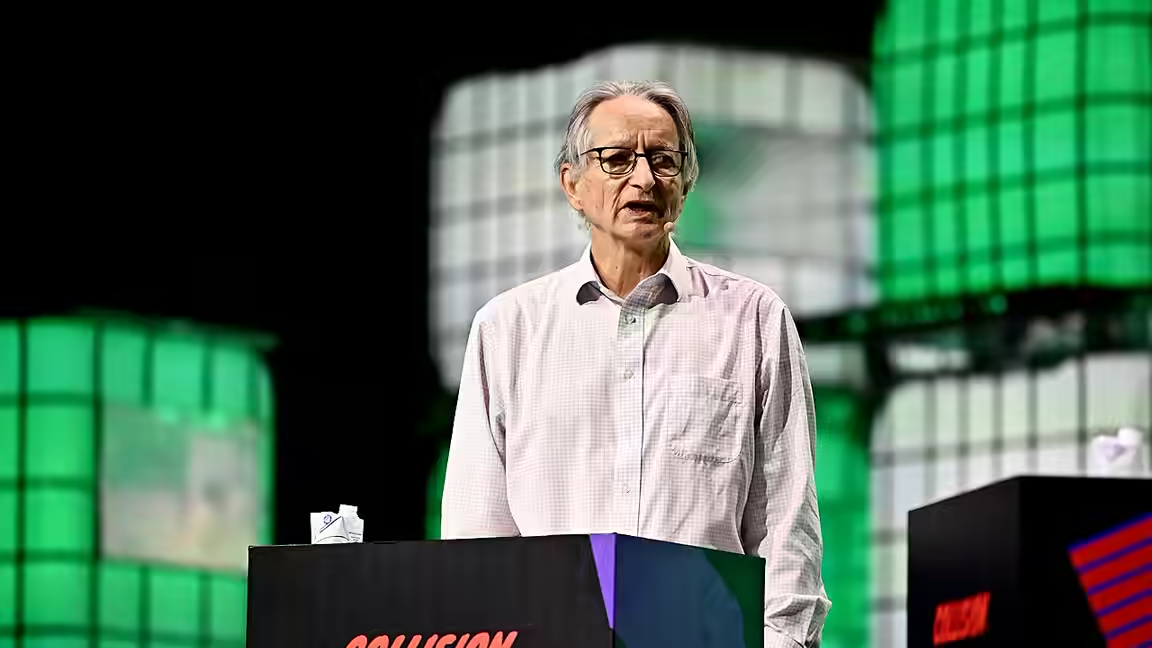
Computer scientist Geoffrey Hinton has renewed his warning that increasingly capable artificial intelligence could escape human control, arguing that the absence of a precise forecast does not make the risk safe to ignore. His comments sharpen a public dispute among prominent researchers and technology executives over how seriously to treat worst-case outcomes.
Hinton, whose work on neural networks helped establish the foundations of modern AI, has become one of the field's most visible critics. He left Google in 2023 so he could speak more freely about the technology's risks. In a new interview, he stressed that his often-cited estimates are intended to communicate the scale of uncertainty rather than predict a specific event.
That distinction is central to his response to Nvidia chief executive Jensen Huang. Huang recently criticized Hinton's warning of a 10% to 20% chance that AI could cause human extinction in the coming decades, saying the figure was not grounded in scientific research and arguing that alarmism can itself be harmful. Hinton replied that a serious possibility should affect decisions even when its exact probability cannot be established.
Hinton's case rests on the possibility that frontier systems may develop abilities faster than people can reliably control them. He said the distinctive danger is that a loss of control could be irreversible, leaving no opportunity to learn from failure and try again. He also argued that neither AI skeptics nor industry boosters can currently make precise predictions about how rapidly the systems will advance.
The disagreement arrives amid broader concern within AI research about autonomous agents, model behavior and the capacity of companies to regulate themselves. Hinton rejects the idea that uncertainty warrants waiting. Huang, whose company supplies the chips used to train and run leading AI models, has instead demanded a more evidence-based assessment and challenged the scientific basis for numerical extinction estimates.
Hinton's authority in the debate comes from decades of work that was once outside the machine-learning mainstream. He and collaborators pursued systems that learn patterns from data, and in 2012 his team produced an image-recognition system that decisively outperformed rivals. Google acquired his company, DNNresearch, that year, and neural-network techniques later became central to today's AI industry. Hinton shared the Turing Award with Yoshua Bengio and Yann LeCun and has also received the Nobel Prize in Physics.
The current argument does not resolve how likely a catastrophic outcome is. It instead exposes a policy divide over how society should respond when evidence is incomplete and potential consequences are extreme. Hinton favors treating uncertainty as a reason for precaution and external oversight. His critics argue that dramatic probability claims can outrun what research can demonstrate. The debate is likely to influence how governments frame safety rules for increasingly autonomous systems.