![Tartrazine dye in a glass bottle. Late 19th century. BASF company, Ludwigshafen am Rhein. C.I. Acid yellow 23, Food yellow 4 [19140].](/media/articles/commons-b5724c4ee434.avif)
An independent experiment has produced partial transparency in a thin piece of raw chicken breast after soaking it in a tartrazine solution. Tartrazine is a yellow-orange food dye used in some snack foods, but the work relied on laboratory-grade powder rather than seasoning scraped from a branded product. The result was a limited home replication of research on changing the optical properties of biological tissue.
The experimenter prepared several dye concentrations and a water control, then soaked small pieces cut from a roughly five-millimeter slab of chicken. The first trial did not yield a transparent sample: the most concentrated mixture crystallized, while a middle-strength solution made the tissue look gelatinous but still opaque. The water-soaked control remained opaque.
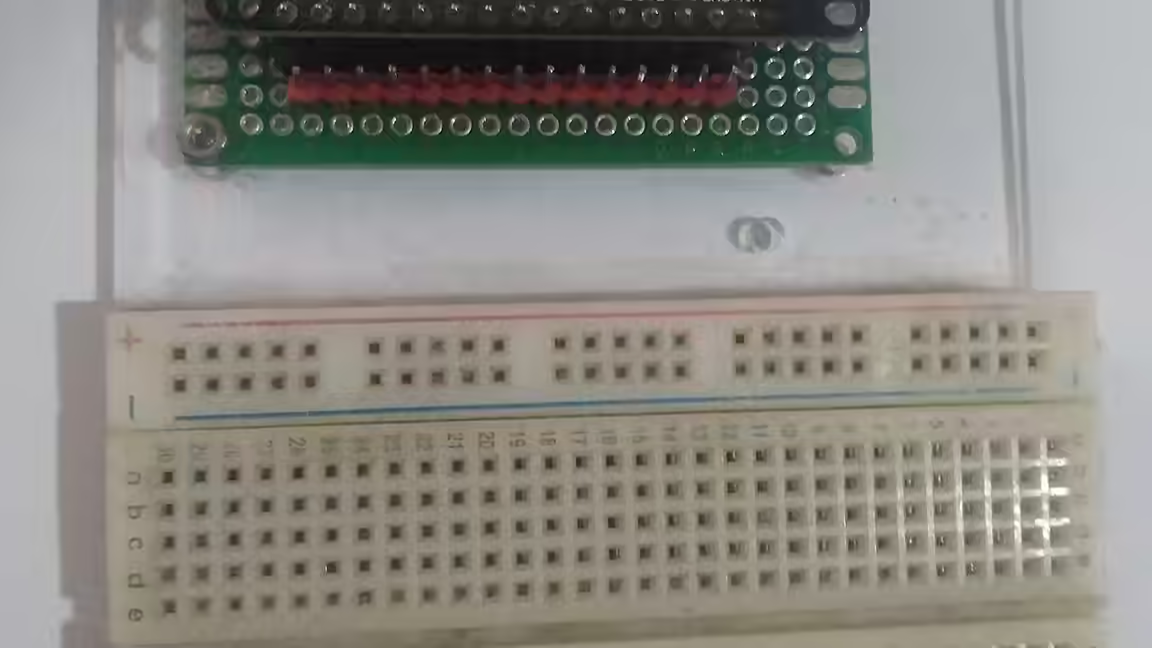
In a later attempt, the experimenter used a solution estimated at about 0.19 molar and cut the treated tissue down to approximately two millimeters. After six hours at room temperature, grid lines placed beneath part of the sample could be seen through it under a desk light. A longer covered soak also produced slight visible translucency compared with the control. The author repeatedly describes the outcome as partial and less dramatic than the published research that inspired it.
The source paper’s protocol, as summarized by the experimenter, used a stronger 0.62 molar solution, a temperature of 40 degrees Celsius and mechanical shaking. Those conditions were not reproduced because the home setup lacked suitable equipment and a safe way to maintain them. The powder was specified as more than 80% dye, adding uncertainty to the estimated concentrations. Those differences mean the demonstration should not be treated as a direct replication of the original protocol.
The physical idea is to reduce light scattering inside tissue. Biological material contains water, proteins and lipids with different refractive properties, causing light to change direction repeatedly rather than pass cleanly through. The experimenter’s account says tartrazine changes both absorption and the refractive behavior of the water, bringing it closer to surrounding components and allowing more structured light to emerge. The supplied evidence supports that as the experimenter’s explanation, not as a new independent measurement in this trial.
No treated material was intended for consumption. The source explicitly notes the risk from raw chicken, and room-temperature soaking creates an obvious food-safety concern. The work is a visual experiment, not a recipe or evidence that snack dust makes food safe, edible or fully transparent.
The practical interest is low-cost optical observation. If carefully controlled, tissue-clearing approaches can make internal structures easier to image, including in fluorescence research. This small demonstration does not establish a validated imaging tool, but it documents accessible materials, unsuccessful conditions and a modest positive result. Those limitations make the outcome useful as an experimental note while keeping it separate from the stronger claims of the underlying scientific paper.