Mission arrives at its target
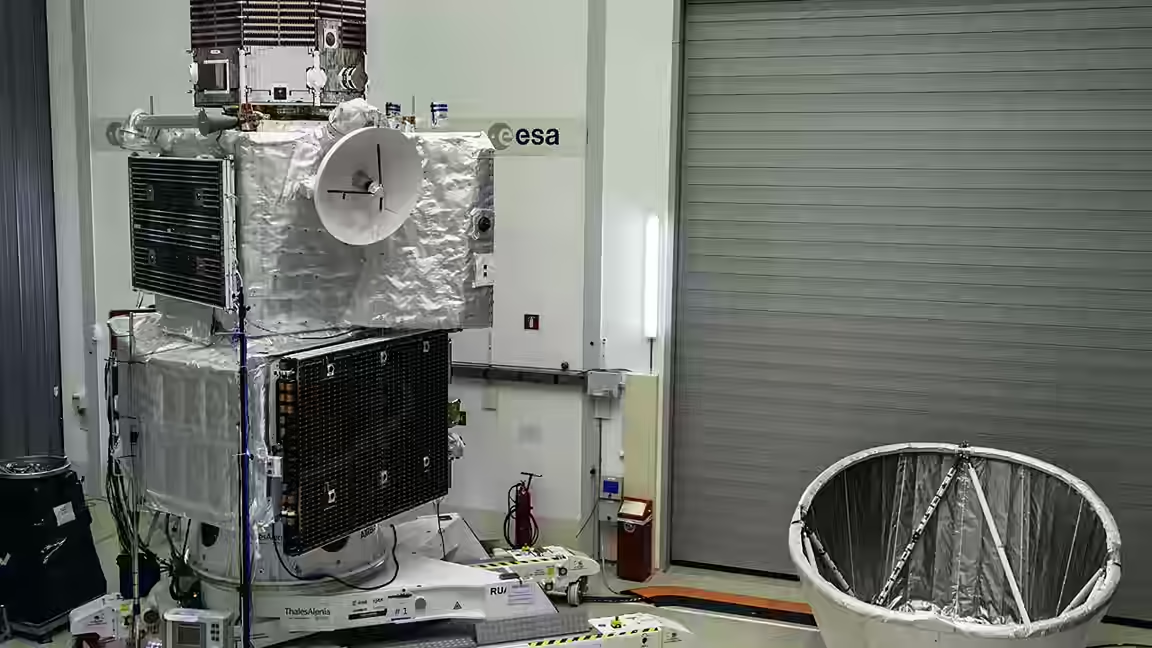
BepiColombo has reached Mercury after an eight-year, roughly six-billion-mile journey, putting the joint European-Japanese project in position to become only the second mission to orbit the planet. Flight controllers planned to fire the spacecraft's thrusters on Saturday to capture it into orbit around the innermost world of the solar system.
The €1.6 billion mission is designed to investigate why Mercury is unusually dense, how it retained a magnetic field and what material lies in permanently shadowed craters near its poles. Reaching the planet is particularly difficult because a spacecraft falling toward the Sun gains speed and must shed energy carefully rather than simply accelerating toward its destination. BepiColombo used a long trajectory to manage that challenge.
The arrival does not mean scientific observations begin immediately. The combined spacecraft is expected to separate in early December into two orbiters that will move into different polar paths. Full science operations are scheduled to start in April 2027, after commissioning and orbital adjustments.
Two spacecraft, complementary instruments
Europe's Mercury Planetary Orbiter will map the surface and its chemical composition at high resolution. It will also probe the planet's interior, helping researchers examine the origin of a core that accounts for an unusually large share of Mercury's structure. The Japanese orbiter will concentrate on the magnetic field and the sodium exosphere, the extremely thin envelope of particles around the planet.
Among the European instruments is the Mercury Imaging X-ray Spectrometer, known as MIXS, which will measure the geochemical makeup of the surface. Other instruments will image the planet at multiple wavelengths, sample its surrounding gases, measure its magnetic environment and use a laser to map its shape. Together, the payloads are intended to connect processes inside Mercury with conditions at its surface and in nearby space.
Mercury presents extreme conditions for the hardware. It lies about 36 million miles from the Sun, while surface temperatures can rise to about 450C in daylight and fall to around minus 180C at night. Its slow rotation means individual locations experience extended periods of light and darkness. Despite being only about half again as wide as Earth's Moon, Mercury has roughly four times the Moon's mass, making its composition a central scientific question.
The two orbiters are expected to work for about three years. When their fuel is exhausted, their orbits will decay and the spacecraft will eventually strike the surface. Before then, researchers expect the paired observations to provide the most detailed account yet of Mercury's interior, exterior and surrounding environment.