Returning to a planetary-defense target
The European Space Agency's Hera spacecraft is preparing to rendezvous with the binary asteroid system targeted by NASA's Double Asteroid Redirection Test. The mission will provide the first detailed post-impact survey of Dimorphos, the small moonlet struck by DART in 2022 as a demonstration of whether a spacecraft could deliberately change an asteroid's motion.
Hera launched aboard a SpaceX Falcon 9 from Cape Canaveral on October 7, 2024. After a journey of just over two years, it is approaching the Didymos-Dimorphos pair at a location about 1.5 astronomical units from the Sun. Initial observations still show the objects as only a few pixels, but the spacecraft is scheduled to begin baseline measurements from roughly 25 to 30 kilometers away in November and December.
Didymos is about 780 meters across and completes one orbit of the Sun every 2.1 years. Its approximately 151-meter companion, Dimorphos, was identified in 2003. Before impact, DART's final images showed Dimorphos as a loosely consolidated “rubble pile,” a structure resembling other asteroids visited by sample-return missions.
DART hit Dimorphos at about 6.6 kilometers per second. Measurements following the collision found that the moonlet's orbit around Didymos, previously 11 hours and 55 minutes, had shortened by roughly 32 minutes. Observers also detected a stream of debris extending from the system in the following weeks.
Measuring what the impact left behind
Hera's close observations are expected to characterize the altered surface, the impact site and the binary system's physical properties. Those measurements can help researchers connect the momentum delivered by DART with the orbital change it produced. That relationship matters for planetary defense because an effective deflection plan would need to predict how a particular asteroid's composition and internal structure influence its response to an impact.
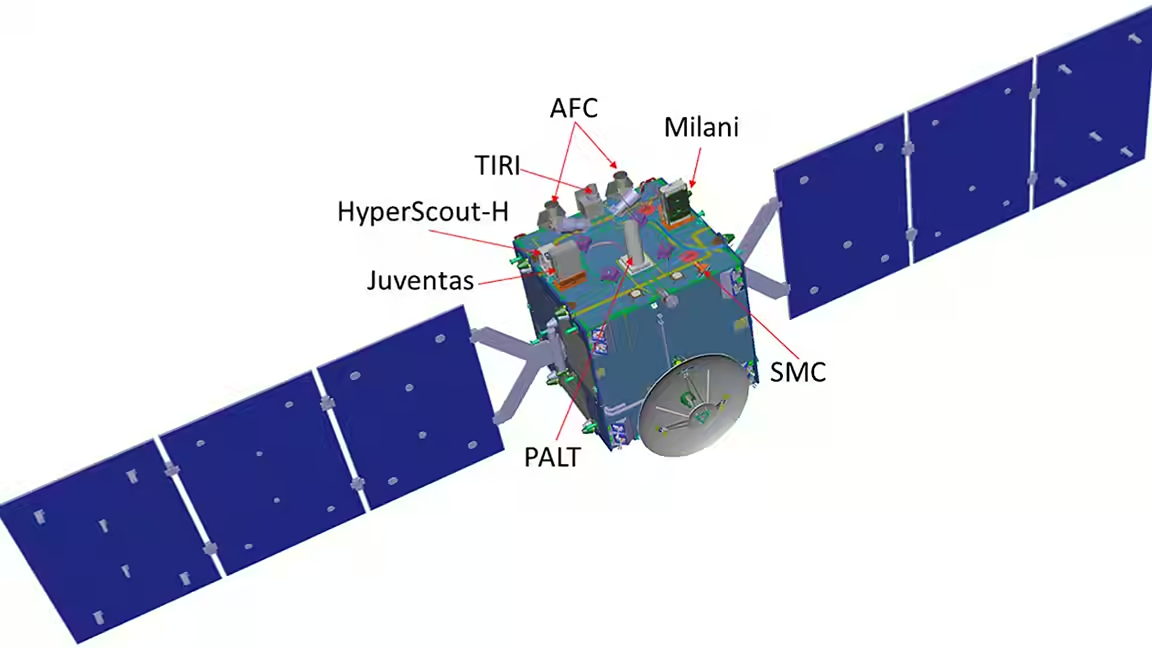
Two CubeSats will extend the investigation after the rendezvous. Milani is designed to study dust around both bodies and examine their spectral composition. Juventas will investigate internal structure and could approach closely enough to come to rest on Dimorphos. The system's extremely weak gravity makes operations near the surface unlike a conventional planetary landing.
Hera is ESA's first mission in its Space Safety Programme class. Its nominal mission is expected to continue into 2027, after which controllers could consider an extension focused on autonomous spacecraft-control technology.
The mission is the measurement half of an experiment that began with DART's collision. DART established that a kinetic impact could alter Dimorphos's orbit; Hera is intended to reveal the asteroid's condition afterward and supply the physical detail needed to interpret that result. Those findings should improve models used to assess whether a similar technique could divert a hazardous object discovered on a future path toward Earth.