A small repair instead of a replacement
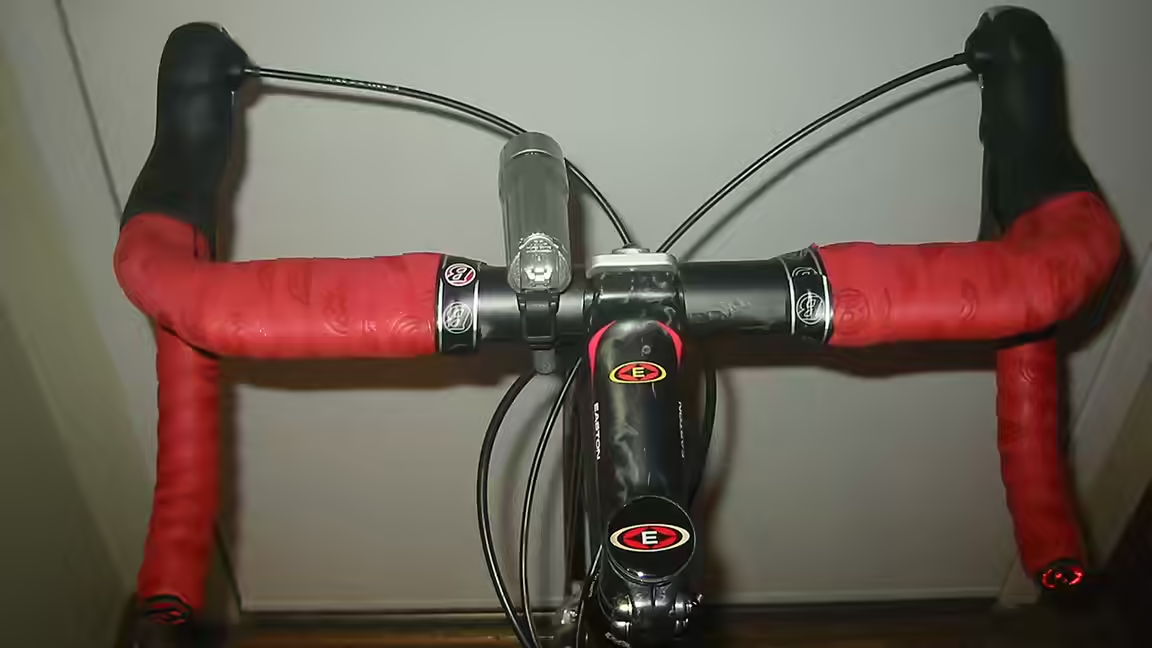
A repair account published on September 27 documents how a pair of roughly ten-year-old rechargeable bicycle lights was returned to use after its batteries could hold only about five minutes of charge. Rather than discard the lights, the owner opened one at a community makerspace and treated the failure as a first electronics-repair project.
The enclosure, described as silicone-like, had to be cut along an apparent seam to reach the circuit board. Screws were removed sparingly so the assembly would be easier to put back together. Once the board was exposed, the battery connection could be identified and desoldered. The writer consulted an iFixit desoldering guide and asked more experienced makerspace members for practical help before attempting work that was new to them.
Identifying the old cell proved less straightforward than removing it. Part of its marking was obscured by a metal tab attached to the battery. A language model suggested the designation LIR2477; the writer then searched for that part and judged its appearance consistent with the original. The replacement cells cost about three dollars each, while adhesive cost eight dollars, and delivery took about two weeks.
Working lights, with limits
After the new batteries arrived, they were installed at the makerspace and the housing was glued closed. The adhesive was allowed to cure for 24 hours. The old cells were taken to a local battery-collection point rather than put in household waste. The repaired lights subsequently worked during nighttime cycling, although the writer had not yet run them through a full recharge cycle and therefore could not estimate the new battery's endurance.
The project cost about 20 Canadian dollars in parts. Its finish was imperfect: the opened housing did not fit together as neatly as before, and the repair's long-term durability remained unknown. Those caveats make the account useful as a repair record rather than a universal instruction manual. The author explicitly said it did not provide safety advice and emphasized the benefit of working in a community space where help was available.
The experiment illustrates both the appeal and friction of extending the life of small rechargeable devices. A failed cell may be inexpensive, yet sealed construction, uncertain component markings, soldering and the need to restore an enclosure can make replacement difficult. In this case, shared tools and advice were enough to turn otherwise unusable lights into functioning equipment while giving their owner a practical introduction to electronics repair.